Wood to Use for Smoking Beef Ribs Reddit
Smoke is the soul of barbecue. It is what differentiates charcoal-broil from other types of cooking.
Originally all barbecue and grilling was washed with logs of wood as the sole fuel source. Energy from the combustion cooked the meat, and fume from the wood and from dripping juices imparted a distinctive seductive scent that is the essence of barbecue. But it is difficult to control energy and flavor when cooking with logs, so today, only a few expert pitmasters outfitted with special rigs cook with logs only.
Today, most grills and smokers employ charcoal or gas to produce the energy, although a few employ wood pellets or electricity. They get season and aroma from the addition of wood in the class of wood chips, chunks, bisquettes, pellets, logs, or sawdust. When heated, they brand fume. Smoke can too come from meat drippings, which are laden with fat, poly peptide, spices, and sugars. Audacious cooks tin also become fume from dried herbs, tea, and even hay.
But not all smoke is created equal.
Smoke is a combination of tiny particles that we tin see in an aerosol mixed with water vapor and a complex cocktail of gases. The exact mixture is crucial and it can add elegant vanilla and brown spice notes or coarse biting or even ash tray taint.
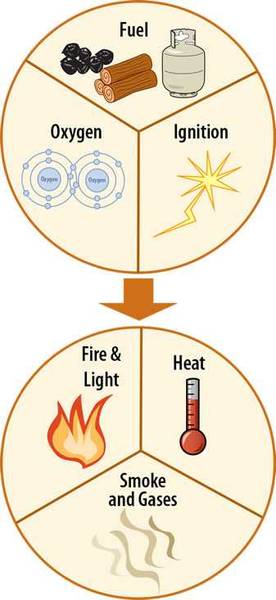
Cookers that go heat from logs, charcoal, gas, pellets, and electricity each produce noticeably dissimilar flavors considering each fuel produces a unique combination of combustion byproducts.
Combustion, every bit it applies to charcoal-broil and grilling, is a sequence of chemical reactions between oxygen and a fuel that is ignited producing a alter in the chemistry of both, creating estrus, calorie-free, and smoke with its blend of particles, water vapor, and gases.
This video gives a practiced overview of this article:
Stop obsessing over which species of woods to use
Before I get into the how forest burns and the different types of smoke, allow'southward get the most common question I get out of the way first: Which woods should I use? My reply: Don't sweat it. It is an impossible question to respond.
Smoke flavour is influenced more by the climate and soil and how much oxygen the fire is getting than the species of woods. This is crucial, specially when you are defenseless up in the game of deciding which wood to use for season. This ways that the differences between hickory grown in Arkansas and hickory grown in New York may be greater than the differences betwixt hickory and pecan grown next. And more important, this ways that hot aggressively burning hickory with lots of oxygen will taste drastically different than the same hickory starved for oxygen and smoldering.
The choice of forest is more important when you are using logs forboth fuel for estrus and for flavor. It is non very important when you are throwing a few chips and chunks into a pile of charcoal or onto a gas grill or even in a pellet smoker.
In general cured (dried) hardwoods with low sap are the all-time, especially hardwoods, fruit woods, and nut woods. They all accept slightly different flavors, andit is incommunicable to describe them. The internet is total of guides attempting to describe the flavors of unlike wood. They remind me of the florid descriptions wine lovers use. Most of them are merely copied and pasted from website to website. I don't observe these descriptions very useful. Most of it is a bunch of hooey. More barbecue mythology. Far more of import than the species of wood is how the forest burns and that determines what is in the smoke. I cannot emphasize this point enough. Controlling combustion is by far the most important attribute of the flavor of fume, far more important than the species of wood. I'll get deep into this in a minute. That said, if you are burning logs, you desire embers that last, and some species burn longer than others. Encounter the table below for that info.
Starting time of all, there are different kinds of each wood. For instance, there'south shagbark hickory, scrub hickory, pignut hickory, red hickory, and more. There's post oak, white oak, black oak, alive oak, pin oak, and more. The climate the tree is grown in tin make a difference. Hot climate drought-stressed Texas oak grown in sand is different than cool climate Michigan oak grown in river silt. Moisture content is crucial. Is the wood still fresh and dark-green? Air stale? Kiln dried? Are you using logs, chunks, fries, or pellets? So throw your spice rub and sauce into the taste contour. Oh, I nearly forgot, then there'due south the quality of the meat. Fresh or frozen? Commodity pork or heritage breed? Do yous really think anyone tin taste a smoked rib with Meathead's Memphis Dust and my KC Classic sauce and tell me what forest was used? Become real.
To make matters worse,in that location is no guarantee that the forest in the pocketbook is the wood on the label! Coffee, olive oil, and fish markets are regularly rocked past scandals of fraudulent labeling. How do we know that the bag of cherry woods sold in the big box hardware shop is really cherry? When Home Depot calls and orders 10,000 bags of hickory and the rickyard only has enough for seven,000 do you know they don't say "gosh we don't accept it, why don't you call somebody else." Y'all call up that maybe they might mix in a little oak to complete the order? Then there are pellets. Almost all woods pellets are at least half oak, with apple, cherry, etc. comprising the rest. They do this to make it feed and burn more easily. Some brands fifty-fifty have flavoring added. What if yous bought a stick of butter and information technology was really one-half margarine?
Hither's the best I can practice based on the woods I have used. I compiled this table from my notes and notes of others, especially from Bill Karu maker of my favorite log burning smoker, the Karubecue. It is crucial that you understand that there are many many variables such as how dry the wood is and the species (there are at least 100 species ofgenus querkus, aka oak). Recollect, I take judged food and wine effectually the world, I take won wine tasting championships in contests where I had to identify wines blind, and I would honey nothing more than to tell you that a detail woods has "nuances of spice with an undertone of mushrooms". I but can't exercise it. There are likewise many variables.
| Genus | Smoke | Energy | Sparks | Embers |
| Alder | Mild | Low | Few | Off-white |
| Apple | Medium | High | Few | Excellent |
| Cerise | Medium | Medium | Few | First-class |
| Hickory | Stiff | Loftier | Few | Excellent |
| Maple | Mild | Loftier | Few | Splendid |
| Mesquite | Strongest | High | Few | Excellent |
| Oaks | Medium | High | Few | Excellent |
| Peach | Medium | Medium | Few | Fair |
| Pear | Medium | High | Few | Fair |
| Pecan | Stiff | High | Few | Skillful |
| Plum | Medium | Loftier | Few | First-class |
| Walnut | Strong | High | Few | Expert |
I avert mesquite although it is very popular in Texas. I detect it to be a bit strong. Hickory is the tried and truthful mate for pork, but some people discover information technology too aggressive and occasionally it can sense of taste bitter. Fruit forest tend to impart a sweetness, but this may just be the ability of suggestion because we know fruit to be sweet. So in that location are the exotic woods: Citrus, pistachio, corn cobs, nut shells, coconut shells, mango, and even mahogany. Who knows?
Choice one wood and stick with it for a while. Fire control and cooking temp, the quality of the meat, the spice rub, the meat temp, and the sauce impact the final taste profile far more than the name on a bag of forest. In one case yous have everything else nether control, then yous can experiment with different wood.
Avoid softwoods.Any you lot do, never use forest from conifers such as pino, fir, cyprus, spruce, redwood, or cedar. They comprise too much sap and terpenes, and they tin can brand the meat taste funny. Some have been known to make people sick. Yeah, I know that cedar planks are popular for cooking salmon on, but I don't know anyone who burns cedar as a smoke woods. I have also heard that elm, eucalyptus, sassafras, and sycamore impart a bad flavor. Many wood are tin be irritants or poisonous, among them oleander, mangrove, laburnum, sassafras, tam-bootie, yew, and poisonous walnut (but non other walnuts). A adept source for general info near wood is the wood database.
Never use lumber scraps. Some lumber is treated with chemicals that are poisonous. Never utilize woods that has been painted. By the way, that'southward ane of the reasons I don't utilise lump charcoal. You tin run into lumber scraps in there and it makes me wonder how careful they are to forbid treated lumber from getting in the bag.
Never use wood that is moldy. Some molds contain toxins.
Apply dry woods.Freshly cut "green" woods accept more sap, burn irregularly, and impart dissimilar flavors than dried wood. Air dried wood is ordinarily slightly wetter than kiln stale. Kiln dried used to be rare only with more than and more than restaurants using wood for grilling, kiln dried has become more than common as health departments demand information technology to kill insects, molds, and bacteria. The forest is placed in a room and heated to 200 to 240°F to drive off the moisture. If you buy kiln dried, ask for 15 to 22% moisture. The water provides steam that makes the droplets larger and stickier.
Bawl or no bawl? Some wood has more bark than others. Some folks say y'all should remove the bark. Bark has more than air in it and is less tightly bound then it will burn differently than heartwood. I don't remove it, but I endeavor to proceed information technology to a minimum. I know tiptop cooks who remove it all. I know one melt who says hickory bawl is the only one good enough to utilize. I champion competitor I know says "I compassion the folks who chip off bawl."
What do I prefer?If I was on a dessert island I would want a bag of apple chunks and a bag of pocket-size apple chips or pellets. I would use the chunks for steady ho-hum release smoke, and the chips or pellets for quick smoke. Apple is mild and rarely tries to have center stage.
Where to get information technology? At that place are a number of charcoal-broil specialty stores opening around the country and there may be one near you. Most hardware stores carry only hickory or mesquite, but a few carry expanded charcoal-broil supplies and a selection of forest. Watch the newspaper for ads from stores promoting a lot of grills. And so give them a call. Another selection is to become to an orchard and ask if you lot can take some dead trees or limbs but be careful, they could be laden with pesticides or other sprays. Also at that place are a number of places to buy wood on the net. Click here for contact info for online wood suppliers.
Hither's my communication. Pick a wood from a single supplier and purchase a lot and and stick with information technology for a year. And so perfect your fire command, the quality of the smoke as described below, temperature command, lock down a source of bully meat, nail you lot salt quantity, build a not bad rub, brand a super sauce. The wood is only i instrument in the orchestra. When you have all the other variables under control, then fool around with different woods.
Burning wood
Hardwoods, deciduous trees which include fruit and nut woods, take compact prison cell structures, and they are the all-time woods for cooking. Softwoods, like pino, fir, spruce, redwood, hemlock, and cypress, are all evergreen, coniferous trees, and they have more air, more than pungent sap, and they burn fast. They are not recommended for cooking. We'll talk more about unlike woods types below.
Fresh cut hardwood has a lot of water in it, up to 80% by weight, it produces a lot of steam and off flavors during combustion, and it takes a lot of energy to dry it out when it is burned. Dead trees can still accept every bit much as 50% wet. That's why most forest for cooking is hardwood that has been stale, a.k.a. seasoned or cured. It can be dried by letting it but sit down around in a stack outdoors or in a shed. Some is stale in a heated kiln. Dried hardwood is rarely totally dry. Pitmasters generally prefer forest that is airdried and 25 to 30% water. Kiln dried wood can incorporate as picayune as 5% water and it is more than expensive. Dry out wood is much lighter, there are cracks and splits, and the bawl is usually loose. Six months is usually enough. Dry out forest burn hotter than woods with some wet in it because much free energy is expended humid off the water.
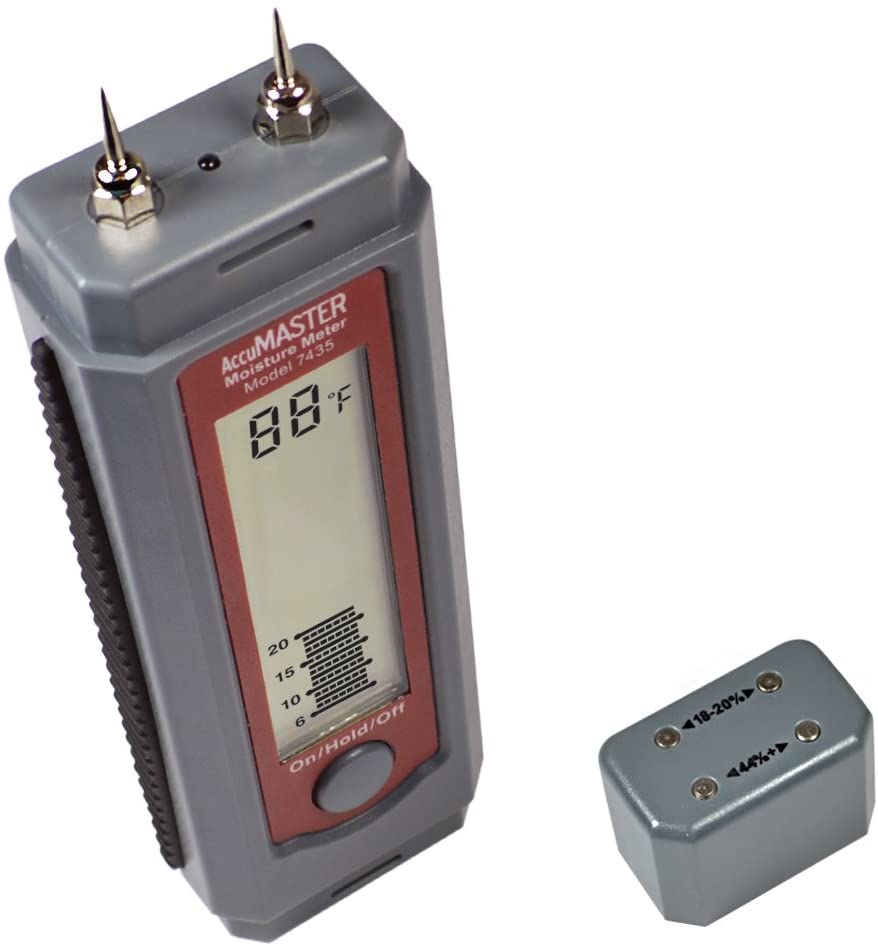
Some pitmasters fifty-fifty buy small-scale handheld meters to test logs. Moisture meters measure the electric resistance since water is a adept conductor and woods is not. Moisture may vary slightly within wood when fresh cutting but with time it tends to reach equilibrium. A 5 pound slice of wood that is 25% moisture holds a pint of water. Hither'south a expert moisture meter from Amazon:
Freshly cutting "green" wood needs calendar month to dry out to ideal moisture. When a tree is cut, the moisture moves out through the ends, the same way it moves through a living tree. Splitting it and cutting information technology to shorter lengths speeds the process. Stacking information technology in a space with airflow speeds the process. Do non bring it indoors considering information technology well-nigh always contains insects. If stacked outdoors put it nether an overhang or cover information technology with a tarp and raise it off the basis although it cannot absorb much water from rain or snow. That's why boats are built from wood.
Not counting the h2o, 40% of wood is cellulose, about 40% hemicelluloses, 19% lignin, and 1% minerals. Bodily numbers will vary depending on the forest species, subspecies, age, soil, and climate. Cellulose and hemicelluloses are big molecules made of carbohydrates and sugars. Cellulose when burned is flavorless. All the flavor comes from lignin. Lignin is another circuitous compound that gives wood strength, and it is found mostly in jail cell walls. The minerals in woods include, potassium, sulfur, sodium, chlorine, carbon, and heavy metals. Although there are only trace amounts, these minerals tin can significantly affect the aroma and smoke flavor. Woods also contains the gases oxygen, nitrogen, and hydrogen making information technology such a good insulator that y'all tin can set 1 end of a stick on fire and hold the other end.
When burned thoroughly in a lab, wood produces about 8,600 BTUs of heat per pound, about half of the mass is converted to carbon dioxide and almost half to water vapor. In the real world of a grill or smoker, woods is never burned thoroughly so at that place are many other byproducts. And we like some of them.
The iv stages of wood burning
Wood called-for goes through four stages. In a typical log called-for pit all iv stages can happen at once.

Stage 1 – Dehydration (up to virtually 500°F). In this stage forest must exist heated from an external source similar a match, kindling, rolled up newspaper, or (horrors) lighter fluid. A lot of free energy is consumed in evaporating the water. Until the wood drys out it cannot get much to a higher place 212°F. Steam and some gases similar carbon dioxide are given off, merely there is no flame or heat produced.
Stage 2 – Decomposition, gassification, and pyrolysis (500 to 700°F). Cellulose and lignin suspension down and boil off much similar the water did in a gaseous cornucopia of volatile organic compounds and particulates. The gases volition burn if in that location is an ignition source similar a flame or spark, just they will non ignite on their own.
Phase 3 – Combustion (700 to one,000°F). Escaping gases burst into flame. You can come across this in a log in a fireplace as gases shoot out through cracks and they ignite and burn orange. Prof. Blonder calls this the "burning bush-league" stage. Other gases emerge, among them nitric oxide (NO) if there is sufficient oxygen. Nitric oxide is essential for germination of the smoke ring in meat. In the sweet spot of about 650 to 750°F, the best aromatic compounds for cooking come off, among them guaiacol and syringol, which are primarily responsible for the aromas we like in smoke. Some are ethereal and misemploy, and that'southward why charcoal-broil doesn't sense of taste the same after it has been reheated. As the temp rises above 750°F, acrid, biting, and perchance hazardous compounds are formed.
Stage 4 – Charcoal germination (above ane,000°F). Virtually of the organic compounds accept burned off leaving behind pure carbon, or char, which burns every bit carmine embers with fiddling smoke, odor, and no flavor. Click here to read more than almost charcoal science and different types of charcoal and how to use them.
What is fume?
Bill Karau designer of the awesome Karubecue told me "All fume is created equal and equally nasty. Look closely at the smoke coming out of a fissure in a log in a fireplace. You'll meet a plumage of thick, yellowish gas. Stick a spoon in that gas for two seconds, let it cool for a few seconds, and and then lick it. Y'all'll exist tasting it two hours later. Revolting. The key to great barbecue is what happens to the smoke after it'southward emitted. Like crude oil, crude smoke can be refined past called-for with flame. And that requires lots of oxygen. You lot don't get that refining when wood is deprived of oxygen and it smolders. With oxygen impecuniousness yous go bad flavors."
Fume includes equally many as 100 compounds in the form of microscopic solids including char, creosote, ash, and phenols, besides every bit combustion gases that include carbon monoxide, carbon dioxide, nitric oxide, syringol, and liquids such every bit water vapor and syringol, an oil.
Trace amounts syringol are responsible for much of the smoke aroma nosotros honey and trace amounts of guaiacol are responsible for much of the sense of taste of fume. The composition of fume depends a great deal on composition of the wood, the temperature of combustion, humidity, and the amount of oxygen available.
If the forest does not get plenty oxygen it tin can however undergo pyrolysis and gasification, just not combustion. It will not burst into flame, it will smolder, and smoldering woods produces lots of smoke and a different flavor than burning wood. Why would it not get plenty oxygen? If the intake vents and chimney are not open wide plenty. Click here to learn more nigh decision-making vents and chimneys. Getting enough air tin be a trouble in kamado type smokers that are so well insulated and retain so much rut that we often take to choke off airflow to keep it from running as well hot.
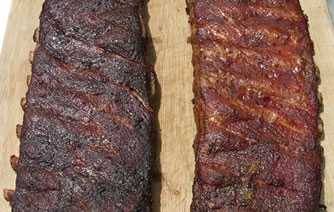
Wood also plays a role in the color of the meat and the formation of the crust on the meat, likewise called the bark. Below are two slabs of ribs with the same spice rub but no sauce. The one on the left was cooked on a charcoal smoker and the one on right was cooked on a gas smoker. You can see and gustatory modality the deviation. They were both fantabulous, but different. The 1 on the right had a fleck of a salary or ham undertone, typical of gas smokers.
Bluish smoke for long cooks
Fume from woods or charcoal for cooking can range from bluish, to white, to gray, to yellow, brownish, and even black. The almost desirable smoke is virtually invisible with a pale blue tint. Y'all can see it below. Blue smoke is the holy grail of low and slow pitmasters, particularly for long cooks.
Prof. Blonder explains that the color depends on the particle size and how information technology scatters and reflects light to our eyes. Stake blue smoke particles are the smallest, less than a micron in size, well-nigh the size of the wavelength of light. Only considering you can't see it, doesn't hateful information technology's not at that place. Pure white fume consists of larger particles, a few microns in size, and they besprinkle all wavelengths in all directions. Gray and black fume contains particles large enough to actually absorb some of the light and colors.
Black and gray smoke happen when the burn down is starving for oxygen, and they can make bitter, sooty nutrient tasting similar an ash tray. Billowing white smoke is common when you simply start the fire, and when the fuel needs lots of oxygen as it goes through stages one (dehydration) and 2 (gasification). If it doesn't get enough and if the fuel is not emitting gases for stage 3 (called-for bush-league combustion), the fuel smolders and produces white fume. For brusk cooks of thin meats, you might just want the heavier, more intense white smoke, and nosotros'll talk over that below. Hither are some tips on how to become blueish smoke for long cooks.
Get your smoke from wood. Don't worry if your wood bursts into flame. A lot of beginners fret over their called-for woods and desire information technology to smolder and belch smoke. You lot'll utilise more wood if you permit it fire, and y'all'll take to struggle a bit to maintain temperature control, but you'll get meliorate flavor.
Charcoal belches flamboyant white smoke when information technology is igniting. You don't want to add together meat until the coals are fully aflame and at their tiptop in heat, when it has a white coat of ash. Then add wood at the offset of the cook. Recall, charcoal is for rut, not flavor. If the temp runs upwards a bit at the showtime of the cook, it's not a big problem. The meat is cold and it can take a picayune extra heat. So, when the wood burns out, stabilize the temp.
Keep your cooker clean. Sticky grease on your cooking grates tin can create black smoke and drip on the food. Grease fume is non good fume. Click hither for more than on cleaning your cooking grates. The black stuff on the walls probably has a lot of condensed creosote in it. A thin layer of neutral carbon is harmless, merely black pasty goo is not. Many contest pitmasters ability wash afterward a cook-off. Click hither for more on cooker cleaning and maintenance.
Let the air flow. Brand sure coals and forest take enough of oxygen. If the fuel is choking for lack of oxygen, it burns incompletely and it can emit off flavored gases and even tin glaze your food with grayness soot. If that happens, become the meat off, rinse it, arrange the fire and put information technology back on. Don't let your embers sit down in ash which can smother them. Keep them on a grate in a higher place the lesser of the firebox. Knock ash off occasionally and if necessary, remove information technology. Only don't be afraid of air. Don't be tempted to command temperature by closing the intake or chimney. The fuel will utilize only the iar it needs. It won't fire hotter once if it getting the air it needs. The fashion to control temperature and smoke quality is with the amount of fuel, not oxygen.
Don't soak your forest. First of all, information technology can't blot the h2o and the h2o on the surface just cools the fire. Read my article on soaking wood. And don't employ freshly cut "green" wood. Boiling off the excess water takes a lot of energy.
Size matters. For long cooks on charcoal, chunks of wood from golf ball to baseball game size work best. For short cooks, like a steak, chicken, or fish, minor chips and peculiarly pellets piece of work best because they produce more fume in a short flare-up. If you are burning only logs, Bill Karau of the bright Karubecue, points out that shorter lengths of logs easier to keep in hot zone.
Build a small-scale hot burn down. You lot want to see flame. Fires burning in the 650 to 750°F range in the hot spots burn off the impurities that can be created in an incomplete secondary combustion. That means that you demand a lot of oxygen and so you want your frazzle vent open all the way. The hot air rising through the chimney will draw in air through the intake vent. You will probably desire it open up broad or close to it. Smoldering forest creates dirty smoke.
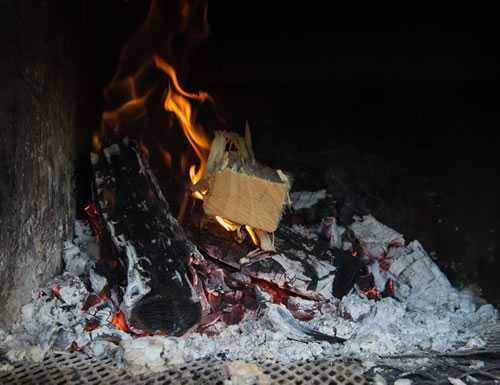
This is why high quality offset smokers are so popular with experienced pitmasters. But there is a big difference between the cheap offsets at the hardware stores and the serious pits made for contest teams and caterers. Cheapo Offset Smokers (COS) include Brinkmann Pitmaster, Brinkmann Smoke'N Pit Professional, Char-Broil Silver Smoker, Char-Broil American Gourmet, and especially the Char-Griller Smokin Pro. They are nil only headaches. The doors don't fit properly then you lot can't command oxygen intake, the walls are sparse then they don't retain heat, and they rust. Expensive Kickoff Pits (EOS) include Horizon, Jambo, Klose, Lang, Meadow Creek, Peoria, Pitmaker, and Yoder to name a few. They are superb cooking tools. The picture below is inside the firebox of Darren Warth'southward Jambo. His team, Iowa'due south Smokey D's, i of the winningest cooks on the circuit. Notice that virtually of it is glowing embers and a log virtually burnt to embers, and there on acme is a small-scale block of hardwood for flavor. Go to our equipment reviews database for ratings and reviews.
This is also a trouble with kamados and eggs. They are and then well insulated and so efficient with the heat right below the meat that they typically burn modest absurd fires and smolder white smoke.
Start charcoal and logs on the side. Offset your logs or charcoal on the side and add just hot embers. I use a chimney in a bicycle barrow. Remember, when information technology is burning properly, charcoal doesn't produce much smoke.
Allow the fire to become rolling and permit the pit to warm up. Kickoff the burn well earlier the food goes on. Warm the walls of the cooker.When a recipe says "preheat" your cooker, do it. Adjust your airflow and get the temp, fire, and smoke stabilized. Be aware of the weather. Information technology is harder to go blue smoke in cold, rainy, or windy weather condition.
Melt indirect. If the meat drips on the burn down, h2o tin douse the embers and fat can burn and produce muddy smoke. These drippings tin can create flavor, especially for brusk fast cooks, merely for long low and slow cooks, they can crusade issues.
Use your senses. Information technology's hard to see the colour of the smoke at night, but the smell should be sweet, with meat and spice fragrances dominating. The smoke aromas should be faint and seductive, mayhap like vanilla, not like a bonfire smell.
Use good thermometers. Cooking is all well-nigh temperature control. You lot need good thermometers in your cooker and in your meat. Enter the digital age and become a digital thermometer. Get i for the meat and i for the cooker. And while nosotros're on the subject of temperature command, let's bust another myth or ii. There is no magic temperature, but in general low temperatures are meliorate than high for smoking. Better smoke retention and less shrinkage and therefore less moisture loss. I recommend 225°F for most meats and 325°F for poultry (college temp to well-baked the skin) because I desire you lot to chief temp control and mastering two temps is easier. Information technology is oft said that yous should not let the temp fluctuate, but temp swings are no big deal as far as the meat is concerned. Call up, meat is about 75% h2o and and then it hardly changes when the surrounding air temp spikes, especially thick pieces like brisket or pork butt. More important is why the temp is swinging. If it is due to poor fire management so the fume quality can veer into a biting range.
Do. Do dry runs without food until you can anticipate when more than fuel is needed, how to adjust the airflow, and how to react when the smoke starts going bad.
White smoke for curt cooks (and when you have a new Pope)
White fume commonly has a compounds from incomplete combustion and prolonged exposure to white fume is not platonic, it can still make good nutrient. If you are cooking hot and fast, white fume is a good way to go some smoke flavour on the nutrient in a hurry. White smoke is best for brusk cooks similar burgers or steak.
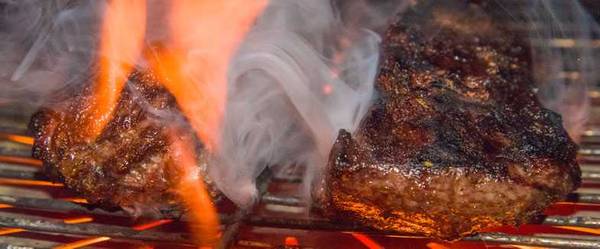
The best way to create white smoke is to deliberately starve the wood of oxygen and go far smolder. Experiment with containers for the forest. Here you can run across a foil packet with holes punched in it and a pocket-sized aluminum loaf pan crimped to restrict airflow. For short cooks, similar a steak, chicken, or fish, small fries and especially pellets work all-time considering they produce more fume in a short outburst.
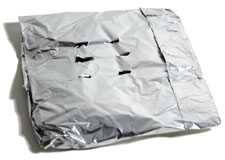
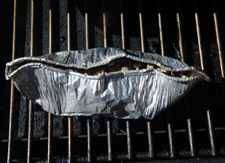
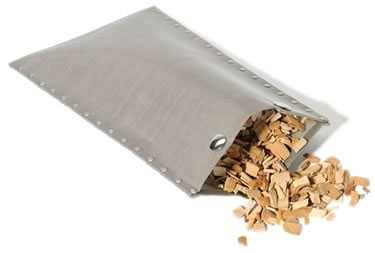
In recent years in that location have been a dozen new products brought on the market to hold woods and add white fume to the cooker. I take played with a number of them, and the one that impresses me the about is this clever blueprint, especially for use with gas grills. It is chosen Mo's Smoking Pouch
Information technology is a pouch of fine mesh stainless steel that holds forest fries or pellets. The airspaces in the mesh are pocket-size enough that they limit the amount of air that gets in so the wood smolders and never bursts into flame. It puts out plenty of white smoke, usually within a few minutes. Best of all, it smokes just by putting it on meridian of the cooking grate or you tin stand information technology on edge and slip it betwixt the grates and the dorsum of your grill. Y'all don't have to squeeze it in down by the burners although you lot tin can if you need to infinite on pinnacle of the grates. And it works. Information technology holds enough wood for about 15 minutes for short cooks, but you need to refill information technology, or buy a 2d pouch, for long cooks like pork shoulder and brisket. Refilling can exist tricky since the steel gets hot and stays hot for a while. If you take good gloves, no trouble.
Creosote
Creosote is amidst the compounds in smoke and it is the Jekyll and Hyde of smoke cooking. On the Dr. Jekyll side, creosote contributes positively to the season and color of smoked foods and acts as a preservative, amongst the reasons that smoking meat was used for preservation before refrigeration. Dr. Blonder says "Creosote is always present in charcoal or forest smoke, and a few components of creosote (guaiacol, syringol, and phenols) are the largest contributors to smoke flavor. No creosote, and the meat might as well have been boiled." On the Mr. Hyde side, "If the residuum of the hundreds of chemicals in creosote shifts, it can gustatory modality bitter rather than smoky."
Commercial creosote is produced by distilling tars from primarily beechwood or bituminous coal (not charcoal). Careful control of the combustion temperature, oxygen flow, and force per unit area produce a wide range of effluvious oils and tars. Creosote from coal tar is the black stuff used to preserve telephone poles and railroad ties. Coal tar creosote is classified as a possible carcinogen. Anybody who has a forest burning fireplace knows that creosote from logs can cling to chimneys, clog them, and even ignite, burning down the house.
These industrial chemicals requite the creosote institute in charcoal-broil smoke a bad proper noun. I am unable to notice any research that implicates the pocket-sized amounts of creosote in barbecue with health risks.
According to Blonder, "When you smoke low and dull at temperatures like 225°F, many smokers crave y'all to control the burn down past damping the oxygen supply which moves it below the platonic combustion zone, creating blackness smoke, soot, and more creosote. Unfortunately, this is often the case with kamado and egg smokers. The all-time smokers combust at a high temp to create the platonic flavor contour and straight a small fraction of the smoke beyond the meat.
To control creosote, do good fire management techniques and do, practice, practice.
Smoke and food
In a smoker or grill, afterwards combustion, the smoke rises and flows from the fire area into the cooking area. Most goes correct up the chimney and very little contacts the food. Blonder explains why: "Effectually every object is a stagnant halo of air chosen the purlieus layer. Depending on airflow, surface roughness, and then on, the stagnant layer of air around a piece of meat might be a millimeter or 2 in thickness. When fume particles approach the meat's surface, they follow that purlieus layer effectually the food. Very few ever affect downward. We've all cursed a grade of this piece of physics while driving: Gnats follow the airstream over the windshields, while larger insects get out green sticky splats at the betoken of touch."
So using a spice rub not only adds flavor, just information technology helps break up the boundary layer.
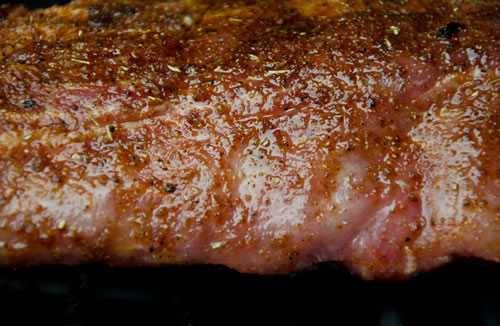
To show the way smoke sticks to food, we did some experiments.
Blonder suspended three cotton wool disks in a smoker at 225°F for thirty minutes. I disk was dry, one soaked in oil, ane soaked in water. The results were pretty dramatic. The atmosphere inside a smoker is equally dumbo as a London fog, yet no visible smoke stuck to the dry cotton fiber pad. Some smoke adhered to the oiled surface, and far more stuck to the wet surface.
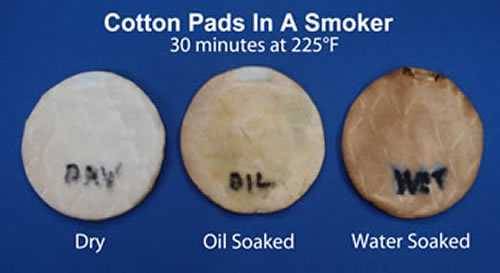
Why does the wet pad assemble so much more smoke? Blonder explains that smoke impacting the dry pad but bounces off considering at that place is aught to concord information technology. Merely the oily and wet pads are tackier. But why does the wet pad concenter more than fume than the oily pad? The respond is thermophoresis, co-ordinate to the physicist.
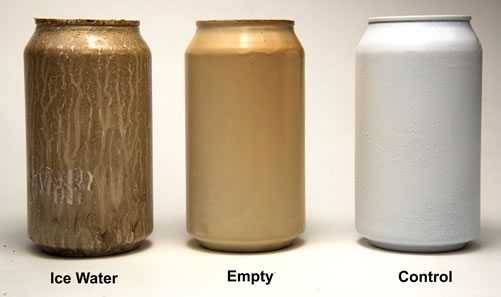
Thermophoresis is a force that moves particles from a warm to a cold surface. Look at the three beer cans hither. Beginning nosotros painted them white. The one on the left was filled with ice water and put in the smoker. The i in the middle was left empty and put in the smoker with the ice water tin. The one on the correct was left empty and saturday on my desk as a control. Y'all can see how much more than smoke the common cold tin attracted. In fact you tin even encounter where condensation on the tin ran downwardly the sides.
In the commencement experiment with cotton pads, in improver to the stickiness of water, the wet cotton fiber pad was cooled by the evaporation of the moisture in the pad so it was well below the temp of the others. That's some other reason why it was smokier.
The same thing happens to meat when you put information technology in the smoker. No matter what temperature your smoker's air is, the center of the meat, which is about 75% water, will never get hotter than 212°F, the humid temp of h2o. It will start at about 38°F, refrigerator temp, and rise to possibly 205°F. In theory the surface could dry out out completely forming a very hard bark and information technology might get hotter than 212°F, just that is rarely the case. In fact, as the interior temp rises to about 200°F, it might even exist hotter than the surface which is still being cooled by evaporation. So if you are cooking at 225°F or higher every bit I recommend, the meat will always exist libation than the air.
To run across thermophoresis in action, practise this experiment: Empty two beer cans the usual way. Make full 1 with water ice common cold h2o and leave the other empty. Put them in your smoker for 30 minutes. Run into which ane is covered with smoke condensate.
Smoke flavor is nigh all on the surface of the nutrient
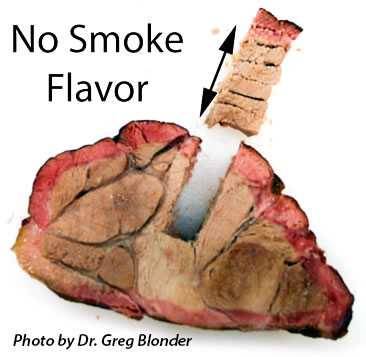
Every bit we see, fume particles and gases glom onto the surface of foods. There they may dissolve and penetrate a tiny bit below the surface but not very far. Rarely more 1/8″. This is the same miracle with marinades. Meats, especially, are difficult to penetrate. Don't believe me? Hither's how to testify information technology to yourself. Get a four pound section of pork loin (non tenderloin). Cut it in half. Do not use rub, and smoke the heck out of i half at 225°F until it is nigh 180°F internal temp. Use every bit much smoke as you lot want. Broil the other half, sans rub, in the indoor oven at 225°F until it is virtually 180°F internal temp. Let them cool a bit and cut a piece out of the middle of each. Now take a core sample of each equally in the picture below. Make sure the eye meat doesn't get to scroll around on the cut board in the juices from the surface if there are whatsoever juices left in this lean cutting. Accept a friend serve the centermost parts to you lot with your optics closed. No smoke!
Also, edifice enough smoke to create flavor takes fourth dimension. On a thin skirt steak for fajitas, there will be much less smoke flavor than on a one 1/2″ thick ribeye steak cooked to medium rare, virtually 130°F. A thick steak will take much less smoke flavor than a chicken breast the same thickness because the chicken needs to be cooked longer, to 165°F. And a turkey chest will have more fume flavor than all of them because it is thicker still.
Does meat stop taking on fume?
At that place is a pop myth that at some point the meat stops taking on smoke. Distressing, but meat does not have doors that it shuts at some time during a cook. In that location is a lot of smoke moving through the cooking sleeping room although sometimes it is not very visible. If the surface is cold or wet, more of it sticks. Usually, late in the melt, the bark gets pretty warm and dry out, and past and then the coals are not producing a lot of fume. Smoke bounces off warm dry surfaces so we are fooled into thinking the meat is somehow saturated with smoke. Throw on a log and baste the meat and it will start taking on smoke again. Just don't drip and then often that you wash off the smoke and rub.
Less is more and enough is enough
I of the biggest mistakes nosotros make is using likewise much smoke. Besides much smoke tin can make your meat bitter or gustatory modality like an ash tray. I cannot give y'all a precise amount because each cooker is dissimilar and the corporeality of wood to get the correct flavour volition depend on the volume of the cooking chamber, the airflow, leaks, how ofttimes y'all peek, the kind of wood y'all use, basting, humidity, the conditions, and of course, your preferences. You volition need to experiment, but a expert rule of thumb is get-go experimenting with about two ounces of wood, regardless of the cutting or weight. For dense, thick cuts of meat such as pork butts for pulled pork or beef brisket, you lot tin double or triple the amount of smoke. If the results are not smoky enough, you can add more wood on your adjacent cook.
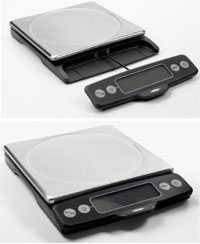
In any case, information technology is best to weigh the amount of forest you use so you can increase or decrease it as you wish in future cooks. Kitchen scales are very useful tools peculiarly for flour and salts for curing. My favorite is the OXO Good Grips Stainless Food Calibration with Pull-Out Brandish
Here'southward where to showtime your experiments: On charcoal, start with no more eight ounces of wood by weight for pork and beef. Use no more 4 ounces for turkey and craven. Add information technology in doses. Put on about two ounces when y'all put on the meat and add together another two ounces when you can no longer see smoke. On gas grills, double the corporeality considering they have a lot of ventilation. Accept notes. If you want more fume afterwards tasting the meat, add it 2 to four ounces at a time on subsequent cooks. Continue records of your experiments on a cooking log.
Unless your cooker is designed for it and unless y'all have a lot of experience, do not try to cook with wood for both heat and flavor. It is likewise hard to control the temp and the corporeality of smoke. When you get an adept, yous may be able to cook with wood only, simply at the start stick to charcoal or gas. If you are gear up to try, read this article on smoking with wood first.
Burning logs
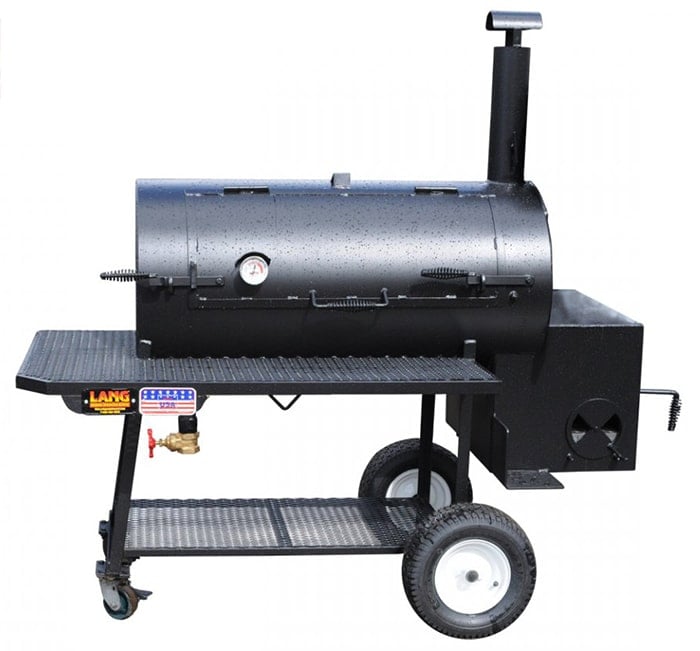
Offset pits, the about pop "stick burners," similar the 48-inch model from Lang shown here, brand superb meats when managed properly. They have 2 major components, the firebox (on the right) and the cooking chamber (on the left). I know you want one, just a give-and-take of caution: They require skill and practise. For example: In order to get a good fire that is not also hot and produces blue smoke, yous don't want to toss in a bunch of logs, low-cal em upwardly, and put the meat on. The results will likely be coated in creosote and taste awful. You demand to burn logs for a while until they are reduced to embers. And then yous add one log at a fourth dimension. You want to control the temperature past controlling the amount of forest and resist the temptation to throttle back on oxygen. So the log must be just the correct size and that may vary from ane day to the side by side depending on the atmospheric condition. I utilize small chunks, about 8 to ten-inches long and on cold days I add more than of them. I proceed my burn well-nigh the size of a shoebox.
Burning propane and natural gas
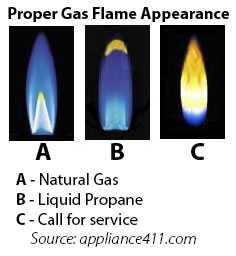
A gas grill has a venturi, a valve that blends the gas and oxygen like a carburetor. When there is too little oxygen some of the fuel is unburned and sooty. The soot glows yellow and orange, like an ember of wood. When properly blended all the fuel is completely burned and the flame is almost blue. Click hither to read more about gas grills and smokers and how they work.
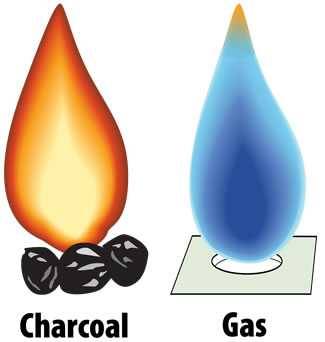
When propane or natural gas combine with oxygen and they are ignited, they produce water vapor, carbon dioxide, carbon monoxide, and not much else. Wood and drippings are needed for flavor.
Burning charcoal
Charcoal is well-nigh pure carbon made from wood that has been preburned in an oven with very picayune oxygen. When burned in a grill or smoker, charcoal, like wood, it burns hotter than woods and produces a lot of combustion byproducts, although fewer than does wood. For a detailed explanation of how information technology is made and how it works, read my article on the Science of Charcoal.
Electricity
Electric cookers use a glowing metal coil for heat, so there is no flame, and no combustion gases. Fifty-fifty if you put wood chips on an electric roll, the flavor of the fume is vastly different, and too many tasters, junior for well-nigh foods considering information technology lacks the complexity that the combustion gases from forest or charcoal produce. Even though propane or natural gas don't produce a lot of combustion gases, they fire at a hotter temperature producing better fume. Read my article on electric smokers.
Putting woods to work
So here's how to take advantage of this info.
Employ common cold meat. As described above, smoke is attracted to cold meat. Do non let the meat come up to room temp. As well, it takes forever for meat to come up to room temp. Yet another myth.
Apply a spice rub. Rough up the surface with a spice rub. A layer of spices and herbs helps to reduce the boundary layer then more smoke will stick.
Keep the meat moist. You can practise this by spritzing the meat with a spray bottle you lot can buy in a drug store. A mop or basting brush can wash off your spice rub. You can use apple tree juice if you wish, but it adds very little to the flavour in comparison to the rub and sauce. Yous can utilise cranberry or pomegranate for color. But really, all you need is water. And don't worry, opening the cooker every 30 minutes to spritz will not slow the cooking process measurably. Yet another myth.
Add humidity to the atmosphere with a water pan in the smoker. And don't bother putting juice or beer in there. Use water pans in your smoker. They add water to the temper, simply more importantly the water slows evaporation keeping the meat's surface moist.
Add together forest early but merely afterward the burn is hot. Meat soaks upwards more than wood flavor at the start of the cook, and the colder the meat the more than smoke it absorbs. But don't put meat into a cooker with charcoal that is not fully engaged and belching smoke.
The dissimilar shapes of wood
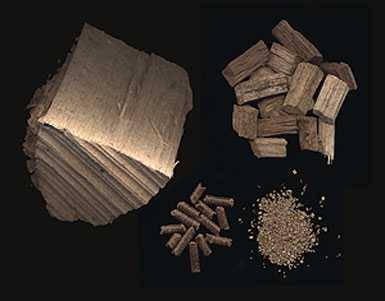
Logs. Most barbecue wood are cutting from hardwoods, fruitwoods, and nut-wood, but never pino and softwoods that take a lot of terpenes and sap. Logs must exist dried. Here is a pocket-sized part of the acre sized pile of post oak at Kreuz Market in Lockhart. TX.
Some cooks throw whole logs into their pits, but y'all must take the correct pit and skill set to pull this off. Done improperly this tin can easily ruin your meat.
More unremarkably, "stick burners" preburn the logs reducing them to embers before cooking with them. Smoking with logs usually needs to be done at a higher temp, perhaps 275°F rather than 225°F because the fire must be hot in club to create clean smoke. Click here for more on cooking with logs.
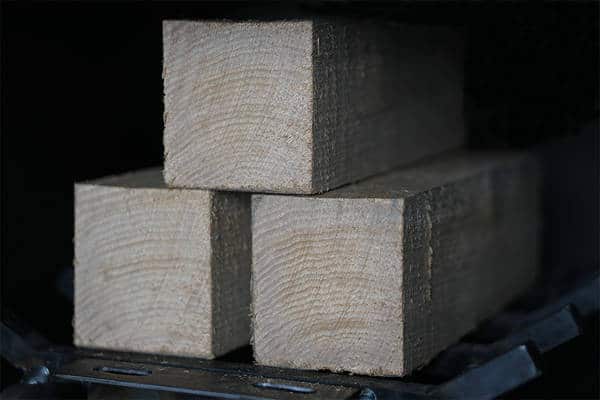
Squogs. In 2018 Ole Hickory Pits introduced Squogs, hickory logs that have been milled square like lumber into uniform 3.5 ten 3.v x 12″ blocks. They are designed for stick burning pits similar the ones they manufacture. They have some real advantages. There is no bark so they are consistent quality, they stack neatly on pallets, and bark is frequently dirty, flakes off, and hides bugs. Very clever.
Chunks. Wood chunks from golf ball to fist size are fairly easy to find in hardware stores. Chunks burn more slowly that chips, and often a chunk or 2 virtually the size of an egg weighing 2 to 4 ounces is all that is necessary for a load of nutrient. Because they are irksome, steady sources of smoke, they are in many ways, the most desirable. When y'all apply chunks, you tin can add i or two at the start of the cooking cycle and you don't need to keep opening the unit and mess with the equilibrium in the cooking chamber'southward atmosphere.
Chips. Almost the size of coins, chips are likewise mutual and easy to notice. They burn quickly and you may find that you need to add them more than one time during the cooking cycle. Fries are fine for short cooks, but for long cooks, chunks are better.
Pellets.Pellets are made past compressing wet sawdust and extruding information technology in long pencil thick rods. They are broken into small bits about 1/2″ long. Food grade pellets contain no binders, glue or adhesives, and when they get moisture they revert to sawdust immediately. Some smokers use pellets as the main fuel, for both flavour and oestrus and pellet cookers exercise very very well in contest. Considering they can be fed into the fire in a very controlled fashion, usually past an auger, pellet cookers can exist regulated with a thermostat, making them very controllable. They fire very hot and make clean.
Nutrient grade pellets can exist a good source of smoke season on grills and smokers for short cooks, and a handful or 2 is normally all that is necessary for poultry.
Pellets used every bit fuel to fire pellet grills are more often than not oak, a stable burning wood. If they say they are hickory, they are normally less than half hickory, a fact that does not ever appear on the label. They ordinarily come in 10 to 40 pound bags.
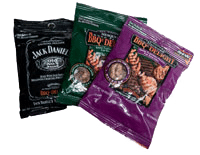
BBQr's Delight makes a dozen flavors of pellets in modest 1/x pound or i pound bags that are 100% flavor wood including alder, apple, blood-red, hickory, orange, pecan, and others. Their Jack Daniel's pellets are a mix of oak and charcoal from oak whiskey barrels, and their Savory Herb is oak with herbs in the blend. I love using these products because they are like shooting fish in a barrel to measure and control. They only burn for almost twenty minutes at 225°F, so you must become your meat on before the wood.
Click here to learn more than virtually pellet smokers, how they piece of work, and get a link to our reviews of more than a dozen of these new devices..
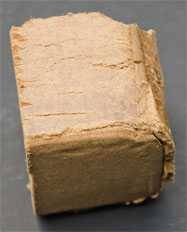
Bricks.Another course of pellet is the brick, the near notable existence made by Mojo-Bricks (right). These are forest chips and sawdust from the mills compressed until they demark. They come in a number of flavors. I take had very proficient luck with them on a variety of smokers.
Bisquettes. Bisquettes are another variation on the compressed sawdust idea made for the Bradley Smoker. They expect similar minor brown hockey pucks.
Sawdust. Sawdust tin besides be used for flavour, but it burns chop-chop and is rarely used. There are fifty-fifty a few small smokers, like the Camerons, that utilize smoldering sawdust. It can be used effectively on thin, fast cooking foods like fish filets.
For gas grills
Getting smoke on gas grills is sometimes tricky. Yous need to experiment. On your grill you may prefer the flavor of smoldering chunks or fast burning fries. Gustation is a matter of taste. Here are some things to attempt.
Get a charcoal help.Sometimes wood merely won't burn. A reader, Nei Ng, constitute a solution: "The first thing to do is to wrap the wood in foil similar the forest scrap pouches. Make a modest pile of charcoal on the flavor bars [or heat dispersers]. They will ignite, but the pile isn't hot enough to really modify the overall temperature, and the wood should exist lit by the fourth dimension the grill has reached 225°F. Place the wood over the hot charcoal and it should offset smoking inside a few minutes."
The foil pouch for chips. Put wood fries in a foil pouch or make a smoke bomb (elsewhere on this page). For a pouch, use heavy duty foil or two or three layers or regular foil. Poke holes in the top so the fume can escape. Identify the pouch equally close to the heat as possible. Reader Jeff Unhurt has this tip: "Make up a agglomeration of pouches in advance. When 1 is burnt up… throw some other one on." You will know when to add a new pouch when the smoke stops. Another pick is to use a pocket-sized aluminum pan with holes poked in the bottom.
If y'all are having problems getting the wood in a pouch to smoke, before you put the meat on, turn the burner on loftier, put the foil packet on and look for the fries to begin smoking. So dial the burner downwardly so you can become the oven to 225°F. Or try Nei Ng's technique of using charcoal (higher up).
Try putting the woods in a minor cast-iron frying pan or a flattened steel can.
If the wood burns.It is possible that your wood might just catch on fire and not smolder. Don't worry! Remember, small hot fires produce the all-time tasting smoke. Yous volition use more wood than if y'all let it smolder, just you may just like the flavor improve.
Smoking indoors with sawdust
If y'all have a proficient exhaust system smoking with sawdust works well. If yous have a wimpy fan, don't even think about it.
The best source of sawdust is to take a scattering of wood pellets, get them wet, and either allow them air dry or pan dry them on a low temp. You can get quality hardwood sawdust from a local chiffonier maker or lumber k, but often it is mixed with pine and other forest.
Get a stainless roasting pan, encompass the lesser with heavy duty foil. Sprinkle sawdust on acme and identify a layer of foil over it, just not all the way to the edge. This keeps drippings from extinguishing the smoldering wood and allows the fume to escape effectually the edges. Place a rack like a pie cooling rack above the sawdust sandwich. The food goes on the rack, and then cover the whole shootin' match. You tin can make a cover several means.
- Lay a second, identical roasting pan upside down on top, and clamp it down with metal or wooden clothes pins.
- Lay a sheet pan on top of the roasting pan and weight information technology downward with a sauce pan or a brick.
- You can fashion a lid from foil, but crimp it tight around the edges. Foil is a practiced method if you need to insert a food thermometer or if the food is tall.
Place the whole shooting match on peak of the burners on the stove and crank up the exhaust. When the smoke stops, you lot can check the meat temp. If it is not done, popular it into the oven at nearly 325°F.
Meathead'southward fume bombs
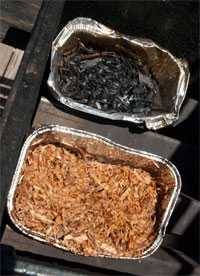
This method is ideal for both gas and charcoal cookers when yous take a long cook and getting nether the grate will be catchy, like when there'south a full packer brisket on board.
Go two disposable aluminum loaf pans. Add dry wood to both. Pour plenty water in one to embrace the woods. The dry pan volition start to smoke rapidly. About fifteen minutes later on information technology is all consumed, the other pan volition accept dried out and begun smoking.
Getting the correct amounts of wood and water may take you lot a few cooks to perfect, but y'all will figure it out. I can tell that much about you.
Smoking with herbs
We take a nice herb garden and at the stop of the season there are e'er a few unpicked oregano, basil, and other herb bushes. I cut them higher up the roots, and stick them in paper bags to dry. And so I crumble them, and I throw them on the grill after the meat is on. They burn down fast, put out a lot of smoke that smells like you are doing something illegal, and add an exotic aroma to the food. I employ them mostly on my gas grill on seafood, which cooks quickly and doesn't have time to absorb slowly smoldering hardwood.
Tea smoking
Chinese cooking often calls for tea smoking. Make a foil packet of these ingredients and place it under the meat.
i/four cup tea leaves
1/4 cup brown sugar
1/4 cup rice
zest of i orange
6 whole star anise pods
ii (iii″ long) cinnamon sticks
1 tablespoon powdered ginger
Bottom line
Sterling Ball is a champion pitmaster whose trophies include the Kansas Metropolis Majestic Invitational also owns a guitar string business. He describes the art of making tasty smoke as similar to tuning a guitar. "You need control of your instruments, the pit, fuel, oxygen, burn, and heat. And you need to practice."
Click here to see the original unedited data from Blonder's experiments.
Source: https://amazingribs.com/more-technique-and-science/grill-and-smoker-setup-and-firing/what-you-need-know-about-wood-smoke-and/
0 Response to "Wood to Use for Smoking Beef Ribs Reddit"
Postar um comentário